
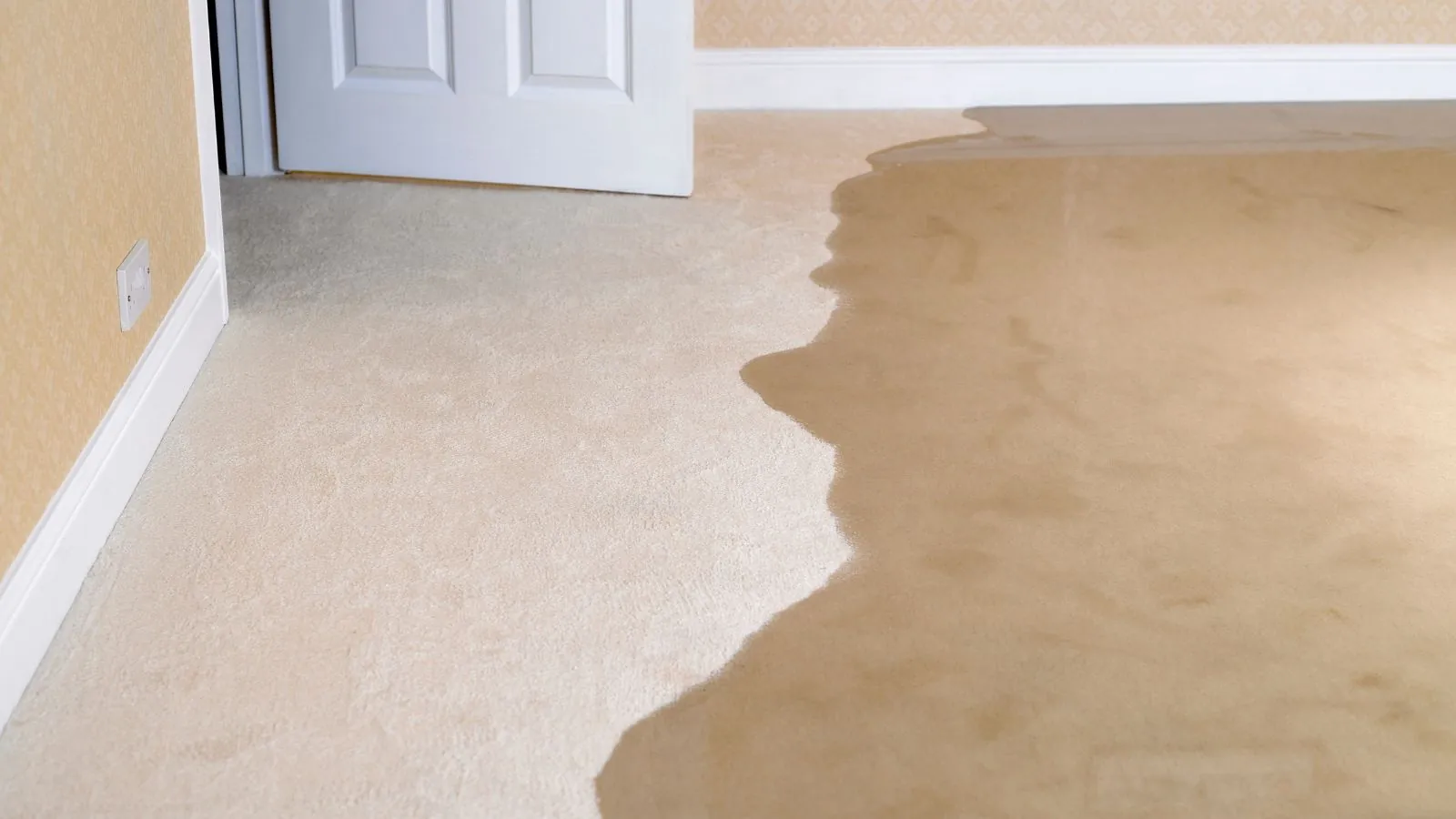
Carpet, pad and subfloor react to water in three different ways
Carpet is a surface layer. Water passes through the fibers and backing quickly, and often the carpet itself can be dried. The pad is the sponge underneath. Foam and rebond pad hold water for a long time, and it releases that moisture slowly into the room. Below that sits the subfloor, which can be plywood, oriented strand board or concrete.
That is why a wet pad is usually the real problem. A carpet may look and feel nearly dry on top while the pad below is still soaked. In a carpeted finished basement, a slab or subfloor under a damp pad is slow to dry without help.
The Census Bureau reports that about 68.6 percent of Draper housing units are owner-occupied, so the save or replace choice often belongs to the household. We lay out what the meter shows so that decision rests on readings.
Signs the pad is wet even if the carpet looks dry
| What you notice | What it points to | What gets checked |
|---|---|---|
| Squishy sound underfoot | A saturated pad | Pad moisture with a probe meter |
| Musty smell near the baseboard | Damp material with little airflow | Edges where the carpet is tacked down |
| Rippling or loose carpet | Backing or tack strip has loosened | Whether the carpet can be re-stretched |
| Dark stains at the wall | Water wicking into the drywall | Wall readings above the baseboard |
| Cold, damp feel on a slab | Moisture rising from the concrete | Slab readings under the pad |
Safety steps for wet carpet in the first hour
Stop the water
Find and shut the valve that feeds the leak. If the source is a drain or sewer, stay off the carpet entirely.
Think about the power
Lamps, power strips and floor outlets sit in the water. Do not touch anything plugged in while standing on wet carpet.
Call for extraction
Call (385) 988-9410. Pulling water out early keeps the pad from soaking fully, and it limits how much carpet has to be replaced.
Lift and photograph
Move furniture off the carpet and photograph the wet area. Do not walk on it more than needed.
According to the EPA, water-damaged areas and items should be dried within 24 to 48 hours to prevent mold growth. The pad is where that clock is hardest to meet. For flooded basements, see emergency water removal.
How wet carpet is extracted, lifted and dried
Identify the water
The source tells us whether the water is clean, gray or contaminated, and that sets the save or replace decision.
Extract
Portable extraction units and truck-mounted units pull water out of the carpet and pad.
Lift and remove the pad
The carpet is detached at a wall and folded back, and a wet pad is cut and removed.
Dry the carpet and subfloor
Air movers float the carpet over a gap, LGR dehumidifiers pull vapor out of the room, and moisture meters track both.
Treat and re-lay
Antimicrobial is applied, a new pad goes down, and the carpet is stretched back and secured.
Hardwood or tile in the same room may need a different plan, which you can read about on the water damage repair page. ANSI/IICRC S500 is a reference many professionals work from for water categories and drying goals.
What drives the cost of saving or replacing carpet
Square footage
More wet floor means more extraction time and more drying equipment.
Water category
Contaminated water usually ends with removal instead of drying.
Pad type
Pad that cannot be dried is replaced, and the type affects materials.
Carpet condition
Older carpet may not re-stretch cleanly after lifting.
Subfloor
Concrete and wood take different lengths of time to dry.
Stairs and seams
Detaching and resetting carpet around stairs and seams adds labor.
Before any work begins, the scope and price are laid out, and we say where drying is an option.
Is your carpet wet right now?
Call (385) 988-9410 and we will tell you what to do before a crew arrives.
How insurers treat wet carpet
Most carriers separate sudden water from a slow leak that has been wetting the carpet for weeks. Ask your insurer whether your policy covers flooring, how it pays for pad, and whether it wants to see the carpet before removal. Keep a piece of removed pad if asked and take photos either way. We cannot promise coverage.
Mistakes that make a wet carpet job harder
- Leaving the pad in place because the top feels dry.
- Running a household vacuum on wet carpet.
- Putting wet furniture back on drying carpet.
- Using a fan alone, with no dehumidifier, so the water moves into walls.
- Waiting a week to see if the smell fades.
Save or replace: how the water category decides
| Water type | Carpet | Pad |
|---|---|---|
| Clean supply water, caught early | Often saved by drying | Usually removed, new pad installed |
| Gray water from a washer or dishwasher | Sometimes cleaned, sometimes replaced | Removed |
| Sewage or flood water | Removed | Removed |
With about 16,981 households in Draper at roughly 2.87 people each, according to the Census Bureau, carpet in family spaces gets heavy use, which is one more reason we check backing and seams before agreeing to a re-stretch. We serve homes in Riverton and South Jordan the same way.
Common questions
Is carpet water damage restoration available in Draper at night or on weekends?
Dispatch is open 24/7, and same-day response is available when a crew is available. We do not promise an arrival time.
Can wet carpet be saved?
Often, if the water was clean and extraction started quickly. Contaminated water means replacement.
Why does the pad get removed?
Pad holds water long after the carpet dries, and drying it in place is slow. Replacing it is the usual route.
Will the carpet shrink or smell after drying?
Carpet that has been dried and re-stretched usually fits again. A lingering smell tells us something is still wet.