
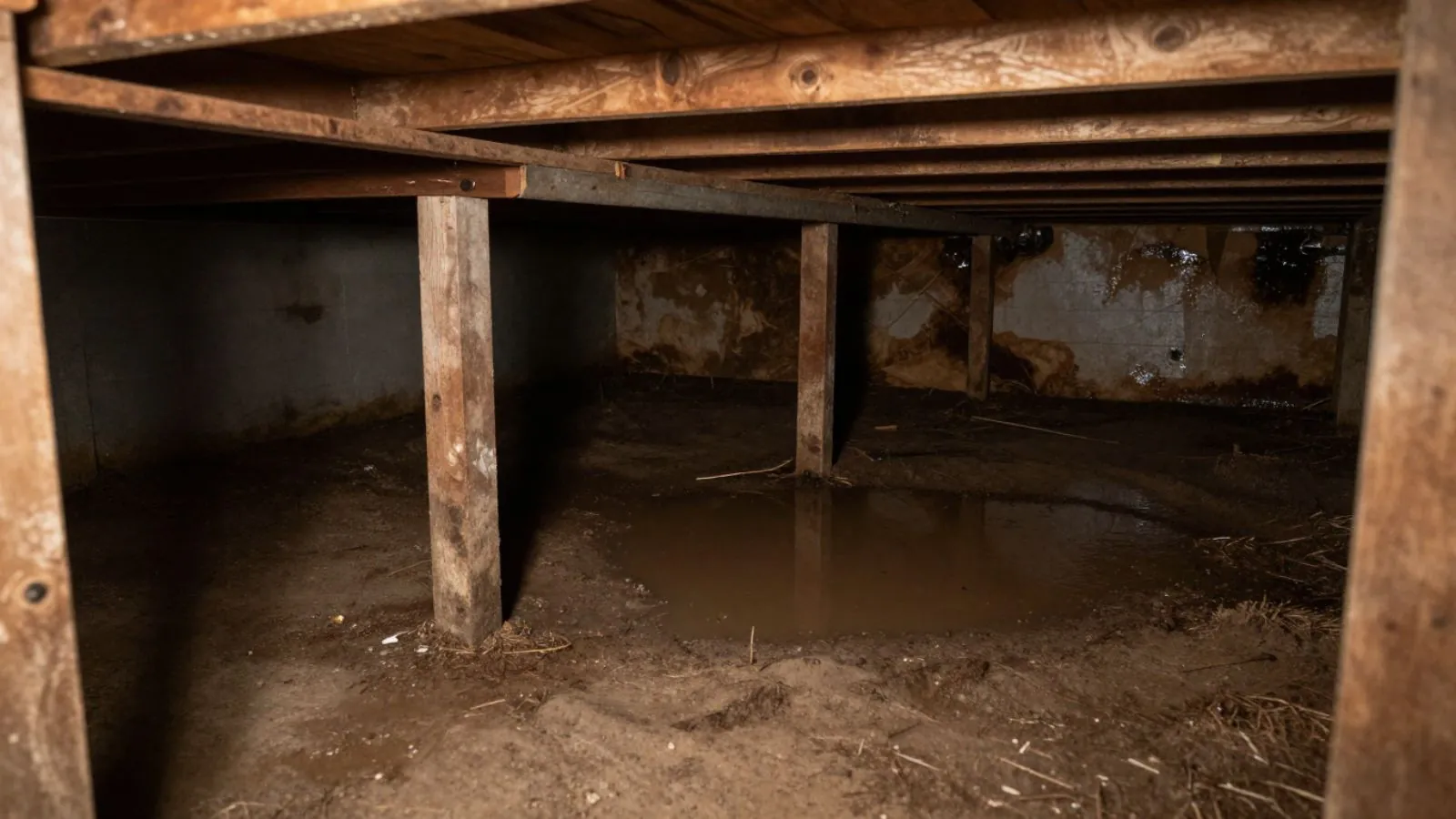
Why wet crawl spaces turn up in only some Draper homes
Full basements are the usual foundation here, which makes crawl spaces the exception. You find them under older homes, additions, porches and bump-outs. We say that plainly because a basement flood needs a different page, and our flood damage restoration page covers it.
Real local causes are modest. A sprinkler line that breaks at spring startup can pour water beside the foundation. A leaking supply or drain line drips onto bare ground for weeks. Snowmelt runs along a poorly graded yard and into a vent or access hatch.
The Utah Geological Survey notes that shallow groundwater can flood basements and other low-lying structures. A crawl space sits even lower in the building, so high groundwater in a wet spring can show up there first.
What a wet crawl space looks like from above
| Sign | What it suggests | Next step |
|---|---|---|
| Cold, soft or bouncy floors | Joists or subfloor are damp from below | Ask for meter readings before replacing flooring |
| Musty odor in the house | Moisture or growth under the floor | Have the space checked, since air moves upward |
| Standing water seen through the hatch | A line, a drain or groundwater has filled the space | Call and keep the hatch closed |
| Sagging insulation between joists | Wet batts have dropped away from the subfloor | Do not pull it down yourself |
Crawl space safety steps and confined space cautions
Stop the supply
Shut off the main or the irrigation valve if a line is the source. Do not crawl in to find the leak.
Stay out of the space
Crawl spaces are tight, wet and dark. Wiring may run through standing water, and you cannot get out quickly.
Call for crews
Call (385) 988-9410 for pumping and drying, and a plumber or irrigation technician for the line.
Document from the hatch
Take dated photos from the opening and note when you first saw water.
Gas lines and electrical cables are often routed under floors. A gas smell means everyone leaves the house first, and the gas utility gets the call from outside.
Pumping and drying the space under the floor
Inspect and map
Moisture meters and a thermal imaging camera check joists, subfloor and the rooms above.
Pump out the water
Submersible pumps clear standing water through the hatch or a vent opening.
Remove wet insulation
Saturated batts come out and are bagged, because wet insulation keeps the subfloor damp.
Dry in place
Air movers and LGR dehumidifiers run until readings match an unaffected area.
Treat and recheck
Antimicrobial goes on exposed framing, HEPA air scrubbers run if material came out, and readings continue.
Dirt floors keep releasing moisture long after the pump stops. That is why we measure before removing equipment and follow ANSI/IICRC S500 as a reference many professionals work from. We do not install vapor barriers or grade soil.
What changes the cost of crawl space water cleanup
Access
A small hatch and low clearance slow every task.
Depth of water
Inches of standing water takes longer than damp soil.
Insulation amount
More wet batts mean more removal and disposal.
Source fixed or not
Drying cannot finish while a line is still running.
Floor above
Wet subfloor and flooring above add scope.
Mold or odor
Growth on framing adds containment and treatment.
Scope is explained before work begins. Tell the dispatcher at (385) 988-9410 how you reach the space and roughly how high the water stands.
Water under your floor?
A crew can be sent the same day when one is available, so call (385) 988-9410 any time.
Crawl space water and insurance
Insurers often separate a sudden line failure from groundwater or seepage. The Utah Geological Survey states that standard homeowners insurance does not cover groundwater flooding, so the cause of the water matters. Ask your insurer how it treats a broken sprinkler line and long-term moisture. We make no promise about what a claim pays.
Mistakes to avoid after crawl space water
- Going in to look without anyone knowing where you are.
- Leaving wet insulation up because the rooms feel fine.
- Sealing the vents so water cannot get out.
- Skipping dehumidification once the pump quits.
Radon, vapor barriers and a damp crawl space
The Utah Department of Environmental Quality says one in three Utah homes test above the EPA action level of 4 picocuries per liter. The EPA calls radon responsible for about 21,000 lung cancer deaths a year. Wet soil and open ground can raise the question, so consider testing.
The EPA's radon-resistant construction basics call for 6 mil polyethylene sheeting over a gravel layer and sealed foundation openings. That is guidance for new building, but it shows why a vapor barrier matters. Our mold remediation page covers growth. Basements in Alpine and Herriman are more common than crawl spaces. Slab-related leaks appear on our slab leak page.
Common questions
Is emergency crawl space water damage cleanup available in Draper?
Yes. Dispatch answers 24/7, nights and weekends included. Same-day response is available when a crew is available, and no arrival time is promised.
Are crawl spaces common in Draper?
No. Most homes have full basements, so crawl spaces are usually in older homes, additions and bump-outs.
Can you install a vapor barrier?
No. We dry and clean up. A contractor who does crawl space work handles the barrier and drainage.
Do I need a radon test after water in the crawl space?
The Utah DEQ says one in three Utah homes test above the EPA action level, so a test is a reasonable step on its own. It is a separate question from the water.